The Lockheed P-38 Lightning was a 1930s fighter that served with the United States Army Air Corps (later the Army Air Forces and Air Force) during and shortly after World War II. It first flew in 1939 and was placed in service in 1941. Over the production run from 1941-1945, 10,037 airframes were built. The Lightning had a long service life, with the last examples in American service being retired in 1949, by which time they were re-designated as ZF-38s ("ZF" meaning "obsolete fighter). The type remained in service with other countries until the last operational examples were retired in 1965 by the Honduran Air Force.
The Lightning had an unorthodox appearance. It had twin booms, with a cockpit pod in the center of a long wing. German pilots called the P-38 a "Fork-Tailed Devil," while the Japanese called it "Two Planes, One Pilot."
The P-38L model was powered by twin 1,725 hp engines, which could pull the fighter to 443 mph at 28,000 feet. Stall speed was around 105 mph. At combat speed, the Lightning had a range of 1,300 miles. Its service ceiling was 44,000 feet, and it could climb at 4,750 ft/min. Armed with a 20mm cannon and 4 x .50 inch machine guns, the fighter could also carry a wide variety of rockets, bombs, and extra fuel tanks.
A list and description of the military airplanes of the United States. Feel free to leave suggestions, and I will try to come up with an overview as soon as possible. If you see a mistake and you have a source, please feel free to correct me.
Thursday, December 27, 2012
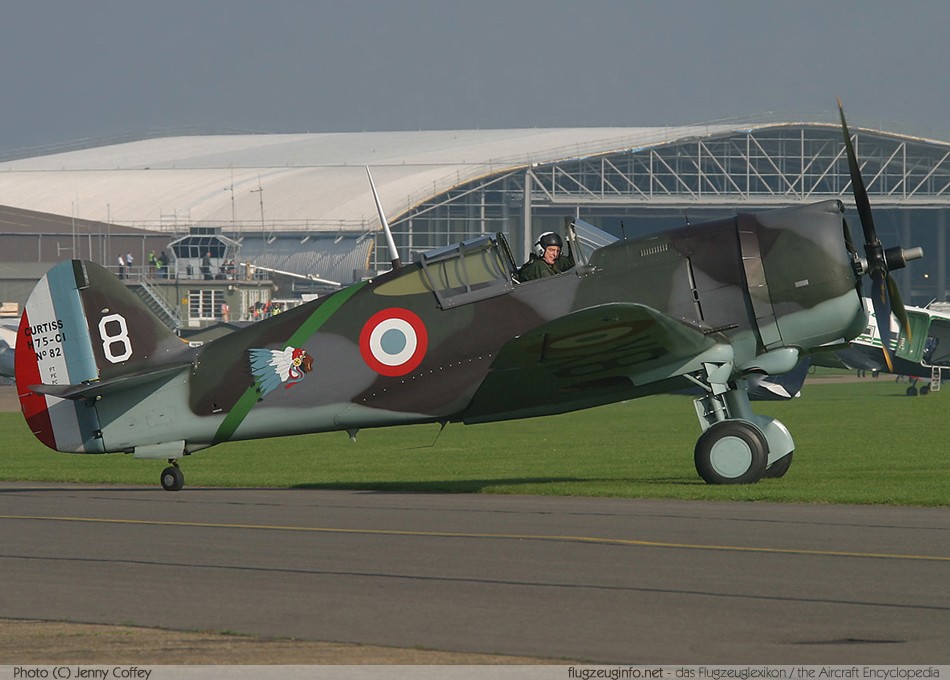
Curtiss P-36 Hawk
The Curtiss P-36 Hawk was a fighter aircraft designed in the 1930s. The Hawk first flew in 1935 and first entered service in 1938. The fighter had a long service life, with the last active aircraft being retired by Argentina in 1954. 215 American airframes and 900 export models were made over the production run. Obsolete by the start of World War II, it was largely replaced by an advanced derivative, the Curtiss P-40 Warhawk.
The P-36 was powered by a 1,050 hp engine that could pull the plane to 313 mph at 8,500 ft, although cruise speed was closer to 270 mph. At this cruise speed, the Hawk could fly 625 miles unrefueled, but the range could be extended to 860 miles by slowing to 200 mph. The fighter could fly at altitudes of 32,700 ft and climb at a rate of 3,400 ft/min. The Hawk was armed with .30 inch or .50 inch machine guns. Later models could carry 200 lbs of bombs on a single hardpoint under each wing.
Monday, December 24, 2012
Seversky P-35
The Seversky P-35 was a fighter aircraft built by the Seversky Aircraft Company for the United States Army Air Corps. It was significant because it was the first single-seat fighter in the US Army Air Corps to use all-metal construction, retractable landing gear, and an enclosed cockpit. Other fighters, such as the Consolidated P-30, had these features, but was a two-seat fighter. The airplane first flew in 1935 and was placed into service in 1937. The P-35 had a long service life, serving the Swedish Air Force until 1952, in a time where jet-powered fighters were becoming commonplace. Over the production run, 196 airframes, including export models, were made.
The P-35 was powered by a 1,050 hp engine that could pull the plane to 290 mph at 12,000 feet. However, cruise speed was closer to 260 mph. Unrefueled, the P-35 could fly 950 miles at a maximum altitude of around 31,000 feet. Maximum rate of climb was around 1,920 ft/min. The fighter was armed with 2 x .30 inch machine guns and 2 x .50 inch machine guns. The P-35 could also carry 350 lbs of bombs.
Saturday, November 24, 2012
Boeing P-26 Peashooter
The Boeing P-26 Peashooter was the first American all-metal production fighter aircraft and the first pursuit monoplane used by the United States Army Air Corps. It first flew in 1932 and remained in service with the United States as late as 1941. The last Peashooters were retired from service with Guatemala in 1956. 151 examples were made over the production run. The single-seat fighter was powered by a 600 hp engine, which could accelerate the airplane to 234 mph. The Peashooter could fly 360 miles in combat or 635 miles while cruising. The airplane could climb to 27,000 feet. For armament, Peashooters carried 2 x .30 inch machine guns, although one gun was sometimes replaced with a .50 inch gun. In addition, the airplane could carry 200 lbs of bombs.
Sunday, October 7, 2012
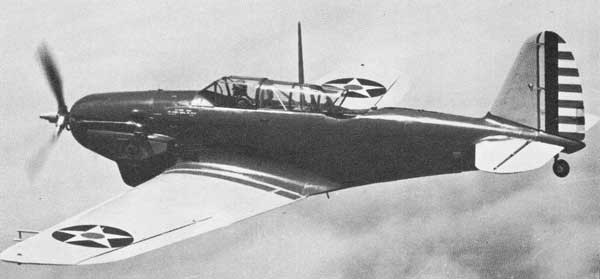
Consolidated P-30
The Consolidated P-30 was a 1930s two-seat fighter plane produced for the United States Army Air Corps. It first flew in 1934 and remained in service as a trainer until 1942. The airplane was powered by a single 700 hp engine that could propel it to 275 mph, even though cruise speed was closer to 215 mph. It had an effective range of 508 miles, and could climb to 28,000 feet, although cruising altitude was around 15,000 feet. The P-30 was armed with twin .30 inch machine guns that fired through the propeller, along with a single flexibly-mounted .30 inch machine gun in the rear cockpit. It could also carry 170 lbs worth of bombs. It was also significant because it was the first fighter in United States Army Air Corps service to have retractable landing gear, an enclosed and heated cockpit, and an exhaust-driven turbosupercharger.
Subscribe to:
Comments (Atom)